
Behind Scorpio Guitars & Ukuleles
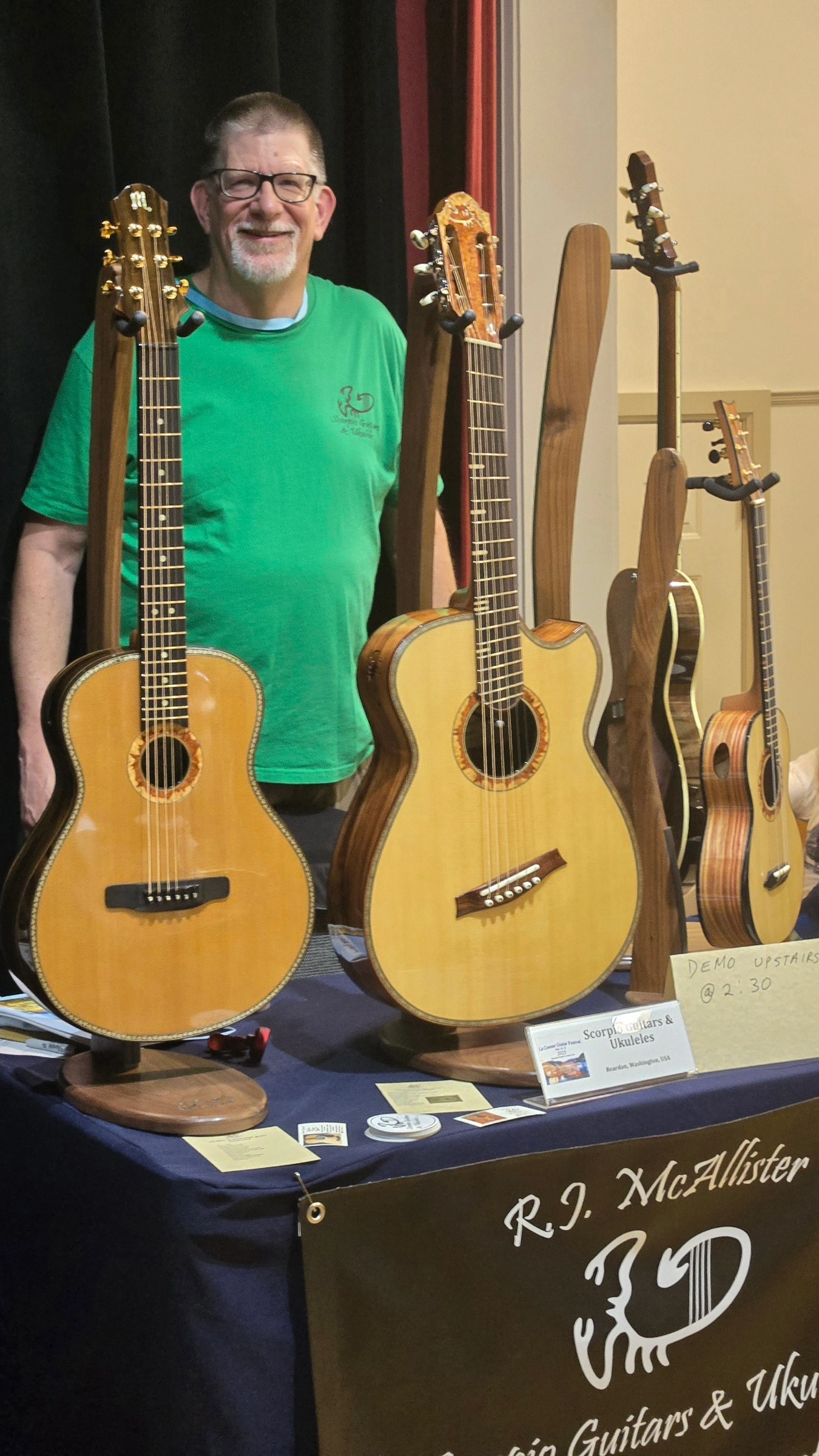
La Conner Guitar Festival
I have always loved music and guitars in particular. I started building guitars in 2012. I fell in love with the wood, the process and fine tuning the sound. It is truly a labor of love. Each piece of wood is unique, and I pay careful attention to achieve the best possible sound. Large guitar companies cannot take the time necessary to fine tune each instrument for maximum tone and performance. I take the time because this is my passion. I cannot keep every guitar and ukulele I make so I started Scorpio Guitars & Ukuleles, LLC to offer some of these instruments to others. I strongly believe that the more you love holding and playing a musical instrument, the more you will practice and expand your abilities as a player. Scorpio Guitars and Ukuleles just sound better plus they are fun and easy to play. Reach for the stars.
- I have studied under Robert O’Brien (obrienguitars.com)
- Charles Fox (americanschooloflutherie.com)
- Trevor Gore (goreguitars.com.au)
- and Larry Robinson (robinsoninlays.com)
I am a member of the Guild of American Luthiers, Association of Stringed Instrument Artisans and the Inland Northwest Luthiers Association. Perfection is always my goal. I back up what I make with a 30-day money back guarantee and a limited lifetime warranty.
Building musical instruments that sound amazing is my passion. I am not in this to make a living but to merely support that passion. I will build custom instruments, and I build them one at a time. Each one is unique and one of a kind. I enjoy making custom instruments that meet your exact specifications. When I am not employed to make a custom instrument, I make a guitar or ukulele that I think is special and offer it for sale.
Sustainable & Solar-Powered Shop
I work from a solar-powered workshop, which is something I’m really proud of. Using renewable energy lets me reduce my carbon footprint while doing what I love. It just feels right to create instruments in a way that respects the world they’ll be played in.
Rob McAllister – Luthier
Why handmade? Why Factory?
An often-discussed topic among guitar players and builders concerns the benefits and shortcomings of buying custom or handmade guitars rather than factory-made. As a builder and former factory employee (though not in a guitar factory), I am understandably inclined towards custom or handmade guitars.
While working in the manufacturing facility of a well-known technology company in Spokane, I learned a lot about how high-volume factories operate. While there is little in common between computers and acoustic guitars, many manufacturing practices apply to both types of products, most notably control of the manufacturing process and predictability. Control of the manufacturing process ensures that at each step, every item is built in exactly the same way, ensuring consistent final products. Predictability depends on the consistency of parts and materials when they are delivered to the factory to be incorporated into the final product. In most cases, customers want to know that what they buy off a shelf full of TVs, computers, or often guitars is of consistent quality, regardless of how many people may have participated in its manufacture, i.e. day or swing shift, stand-in for an absent worker, etc. Another benefit of process control for factories is cost savings, particularly in labor. With a well-developed process, the level of skill required for performing a particular step in the process can be kept at a minimum, with commensurately lower wages paid to that worker.
On the face of it, this is a good thing. Those in charge of the process can rest assured that their workers are producing goods according to the dictates of the product designers, whose designs cannot be compromised by the factory that builds the product, although sometimes the design of a product might be changed to enhance its manufacturability, but that is another story. If a different worker has to perform a specific step in the process, due to turnover or sickness, adherence to the process ensures consistent work, no matter who performs it, so long as they are sufficiently trained. Control and decision-making regarding just how to build the product reside with designers and engineers at levels well above the assembly line worker. The worker makes few decisions and has few options, which minimizes the influence of the human element with the aim of minimizing errors while maximizing consistency and efficiency.
A guitar builder is more directly involved, making many decisions as the construction of the guitar progresses. Such decisions often have to do with compensating for the variability found in all wood, leaving a little more material to add stiffness where needed, or removing a little more because that particular piece of wood may be a bit stiffer. The experienced guitar builder makes decisions of this nature in the quest to build an optimal guitar, rather than meeting the requirements of a set of designer’s drawings created for an assembly line. The experienced builder must be able to compensate for differences in the materials used because no two pieces of wood are the same. Therein lies the dilemma for the high-production guitar factory. In order to compensate for differences in woods, the factory must overbuild their guitars. Here’s why.
Since wood is used, there will be variations in its strength and stiffness. It is simply the nature of wood. For example, a drawing calls for a dimension in top bracing which results in optimum stiffness and mass for the batch of wood presently onhand. That dimension is the smallest possible that will provide sufficient strength or stiffness to counteract the pull of the strings, while at the same time minimizing mass and providing sufficient flexibility for enough vibration to provide good tone. Later, that batch is gone, and the next batch to be used is weaker or less stiff than the previous batch. If the dimensions used for the first, stiff batch are then used for this weaker or less stiff batch, the bracing may no longer be stiff enough to resist the pull of the strings, resulting in excessive deformation of the top of the guitar, and/or poor tone. To avoid this situation, the designer must specify a dimension that guarantees sufficient strength or stiffness whether the wood used is optimally stiff or floppy. To do otherwise invites the burden of excessive warranty work for the factory repairing the guitars whose tops deform due to insufficient stiffness.
It follows then that guitars built to identical dimensions with floppy wood may have optimal stiffness, but excessive mass; those built with stiff wood have excessive mass AND excessive stiffness. Both results can hamper tone. But the individual builder uses his or her expertise to ascertain the whether a particular piece is sufficiently stiff or strong, and makes changes in the dimensions accordingly, as the work progresses, ensuring that the bracing is as low in mass as is practical and allowing sufficient flexibility to be responsive, while still being stiff enough to maintain structural integrity. The builder’s method could never work profitably in a factory due to the high skill level and high wages required for such decisions to occur on-the-fly in a factory; the time needed to determine the need for special work would upset the flow of work down the assembly line. The resulting inconsistency in the rate of flow of products out the back of the assembly line precludes production forecasting, compromising another staple of control in a factory.
Thus the factory must standardize on the dimensions of its top bracing, resulting in some tops being stiffer than is needed and more massive than is needed, with the goal that none is less stiff than is needed. But to optimize the top bracing so that it is just stiff enough with minimum mass, those dimensions must vary according to the particular piece of wood being used, and the high-production factory cannot introduce that sort of decision making to the factory floor. So the very thing that should be variable, bracing dimensions in this example, has to be held constant. And that constant is often results in excessive mass and sometimes excessive stiffness, in order to maintain a margin of safety that will minimize deformation with resulting high rates of warranty repairs.
The buyer’s individual needs must also be considered. I don’t know of any guitar factory that can match the flexibility that a custom builder has to offer. For example, it’s unlikely that a factory can accommodate someone who needs an asymmetrical neck profile, or a special scale length. While many factories offer a wide array of options in terms of trim, wood selection and other visual options, the design and dimensions will likely adhere to that factory’s standard specifications. Car factories make a good analogy. They might offer several trim packages that may transform a particular model, with different trim, interior appointments, wheels, or color schemes, but it’s still the same car underneath. They can’t alter the specifications of their standard models because their tooling and processes are designed to handle only variations across different models.
Same with guitar factories. The custom builder though, is much more flexible and can offer many more changes, such as wedge-shaped bodies, 13-fret necks, fanned frets, and so on. The custom-built guitar is designed from the ground up to meet the needs of the customer, whereas with the factory-built guitar, the customer must choose a guitar that’s already built, and hope it conforms to his or her needs.
Factory-built guitars do have their place, however. For a beginning player, it makes no sense to invest in a custom guitar. It takes awhile for a player to understand his or her requirements, sometimes years, so the investment in a custom guitar in the early stages of learning to play may not make sense. There are indeed many well-built factory guitars on the market for surprisingly low prices and some of them are quite decent instruments, so for the beginner, a factory guitar is probably the best bet, provided that is, that it has been set up properly to be played easily. The exception may be where factory guitars physically do not fit the body of the player, for example, where a player’s shoulders may not permit the extension needed for a conventional guitar. In such a case, a custom might be the only way to meet that player’s needs.
So, for something as personal a possession as a guitar can be to some players, a factory cannot provide the flexibility and range of choices that a good individual builder can. By commissioning a custom guitar, the player and the builder may discuss all aspects of the player’s needs and together design a guitar.
Why I make Guitars and Ukuleles
My name is Rob, and I was born and raised in the Pacific Northwest. I have loved art since I was small. I have always had a strong desire to create beauty. My parents worked in Medicine, but my father enjoyed painting and my mother liked to play the organ and sing. Art was always presented to me as a pastime activity. I was told that art could never be a viable career. Still, I wanted to create beauty. I was fortunate to have access to an art studio at my school and a regular art class. Most classes directed students to work in a particular medium for the semester, but side projects were allowed. I tried drawing, painting, pottery even pastels but I was never satisfied. I had trouble finding the medium that moved my soul. So, I built plastic models from kits. Model cars, boats, and planes. I built models of old Clipper ships. I loved figuring out the rigging and adding the small details. I even mixed kits and created new, crazy contraptions. It was fun, but it was not art.
I eventually tried to make a bookshelf. It looked horrible but I loved it. Working with wood sparked something inside me. A bookshelf is not really art, but I found my medium. But there was no place for me to set up a workshop in my parents’ house. I worked on a few small wood working projects at school when I could, but it required supervision, which had limited availability. Since access to woodworking tools was difficult, I looked for other ways to satisfy my need to create. As an impatient and clumsy youth, I abandoned the notion of being able to create anything physically beautiful. I turned to music. I learned to play the recorder, piano then guitar. I loved playing the guitar so went with that.
When I went to college, I pursued Computer Science because it was a practical skill that pleased my parents and I found I had a knack for it. Working on computers required a lot of my attention and I started to see beauty in a well-designed program. This satisfied my need to create. I got married, started a career as a Software Engineer and raised 2 children. I still played guitar, but it was merely a pastime and there was not much free time for that.
About the time I turned 40, I had a bit of a mid-life crisis and needed a change. So, I started my search for Zen once more. This time I found Scuba Diving. It was a wild adventure that squelched my mid-life crisis and I found beauty in the reefs. I went to several exotic locations to scuba dive. That was fun. From almost every place I went, I ended up bringing home a wood carving made by one of the local artists. I thought to myself, they make a living making art out of wood, why can't I? I then heard my parents' pragmatic voice in my head saying, "Art is only a pastime, you could never make a living making art". After almost 10 years of scuba diving, I had to quit for health reasons. That Zen was gone.
I still loved music though. A few years later, my wife and I attended a local music and art festival. There I found a vendor selling handmade guitars. I fell in love with the beauty and incredible sound of these instruments. Talking to the Luthier selling his guitars was a wonderful experience. I asked a thousand questions. He invited me to attend a monthly gathering of local Luthiers where they swapped stories, tools, and techniques. I got to know several luthiers. I felt like I finally found my people. So, at age 50, I started to learn how to make a handmade guitar from scratch. Here was beauty, music and science combined, and it's made out of wood! Now I can make art that makes more art (music).
During my last 10 years as a Software Engineer, I built guitars in my spare time. Someone once said, “This isn’t like computers at all!” My reply was, “That’s why I do it!”. The answer had popped into my head without any forethought. But on thinking about it later, I realized that’s exactly why I do it. Because it’s not like computers. A lot of what I did at work was enjoyable, especially working with a client to create a solution. During the later years of my career a lot of the opportunity to create new software and solutions disappeared. Work no longer filled the need to create. Building guitars fills that need. When I’m done with an instrument, it makes music. So, I get the satisfaction of the building process, the things I build make music, and my customers have new tools for making their own music. It doesn’t get any better than that.
Check Out My Youtube Videos
Check out some of my guitar and ukulele videos from my YouTube channel. I’ve linked a few of my favorites here so you can see my playing, tips, and tutorials.
Let's Connect!
Whether you're interested in a custom build, have a repair question, or just want to talk instruments—I'd love to hear from you.